
Quantum Dots
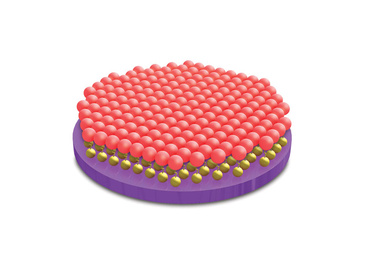 | 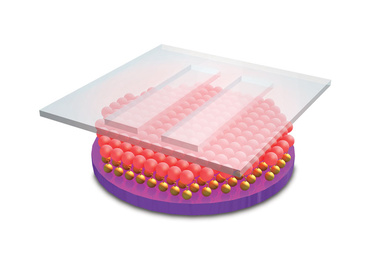 | 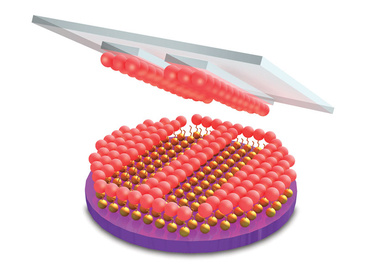 | 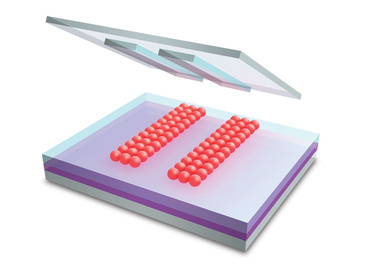 | 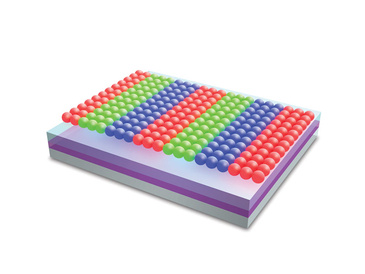 |
| Spin casting of uniform QDs mounted on donor substrates | An elastomer stamp with protruding stripes is pressed against the QDs | Sufficiently high peeling velocity leads to strong adhesion of the QD layer to the surface of the stamp | The stamp is brought into contact with the receiving substrate, which comprises a device stack, and slowly peeled back | Full Colour QD LED created by three individual colours patterned by a sequential transfer-printing process |
Quantum dots (QDs) are fluorescent semiconductor nanoparticles that absorb light energy and, depending on the size of the particle, re-emit the light in a different colour. Therefore, by tuning the size of these particles, you are able to control the colour of the light emitted to any colour in the spectrum.
The advantages of QDs is the fact that they only require a small amount of energy and can be deposited on virtually any substrate, including glass and plastic. They are also superior to organic luminescent materials due to their inherent luminescent properties, such as narrow spectral emission bandwidths, good photostability, controllable bandgap (through size tuning) and high photoluminescence quantum efficiency. These attributes contribute to a reduced production cost and allow QDs to be applied to a wide range of devices.
PROJECT
UniQDS (Universal Framework for Charge Transport in Quantum Dot Systems) is a five-year project funded by the European Research Council (ERC) Advanced Grant FP7.
To date, there has been little research concerning the charge transport dynamics and mechanisms of Quantum Dots (QDs) with basic models. The design and control of charge transport properties in QD systems is important for successful commercialisation as it plays a key role in determining the performance of QD devices such as LEDs/displays, photovoltaics, detectors and image sensors, and thin film transistors (TFTs). The project therefore aims to examine the underlying physics accounting for carrier dynamics, charge transport, and light-matter interaction in various QD systems. The work involves a great deal of inorganic QD design and synthesis, fundamental analysis and characterization, computational engineering, and viable integration technologies, as well as new/potential applications.
Through this understanding the project proposes to increase QD performance, including increased life span and sustainable brightness, and develop technologies and radically new devices, such as lightings and displays, photovoltaics, and field-effect transistors.

NEWS
Twitter account @UNIQDS
TEAM
Professor Jong Min Kim

Professor of Electrical Engineering (1944), University of Cambridge
Personal webpage
Professor SeungNam Cha

Associate Professor in Engineering Science, University of Oxford
Personal webpage
Dr Jung Inn Sohn

Senior Research Fellow, Nano Science and Technology Group, University of Oxford
Personal webpage
Dr Bo Hou

Postdoctoral Researcher, Nano Science and Technology Group
Personal webpage
Paul Giraud

P.h.D Student, Nano Science and Technology Group
Personal webpage
John Hong

P.h.D Student, Nano Science and Technology Group
Personal webpage
Sangyeon Pak

P.h.D Student, Nano Science and Technology Group
Personal webpage
PUBLICATIONS
- Inorganic-ligand exchanging time effect in PbS quantum dot solar cell
2016;Applied Physics Letters;Kim, B.-S. | Hong, J. | Hou, B. | Cho, Y. | Sohn, J.I. |... - Synergistic Effects of a Multifunctional Graphene Based Interlayer on Electrochemical Behavior and Structural Stability
2016;ACS Applied Materials and Interfaces;Lee, Y.-W. | An, G.-H. | Kim, B.-S. | Hong, J. | Pak, S. |... - High Performance PbS Quantum Dot/Graphene Hybrid Solar Cell with Efficient Charge Extraction
2016;ACS Applied Materials and Interfaces;Kim, B.-S. | Neo, D.C.J. | Hou, B. | Park, J.B. | Cho, Y. |... - Synergistic incorporation of hybrid heterobimetal-nitrogen atoms into carbon structures for superior oxygen electroreduction performance
2016;Catalysis Science and Technology;Lee, Y.-W. | An, G.-H. | Lee, S. | Hong, J. | Kim, B.-S. |... - In Situ Synthesis and Characterization of Ge Embedded Electrospun Carbon Nanostructures as High Performance Anode Material for Lithium-Ion Batteries
2016;ACS Applied Materials and Interfaces;Lee, Y.-W. | Kim, D.-M. | Kim, S.-J. | Kim, M.-C. | Choe, H.-S. |... - Hierarchical architecture of hybrid carbon-encapsulated hollow manganese oxide nanotubes with a porous-wall structure for high-performance electrochemical energy storage
2016;Journal of Materials Chemistry A;An, G.-H. | Sohn, J.I. | Ahn, H.-J. - Zinc oxide nanowire-based pressure and temperature sensor
2016;IEEE-NANO 2015 - 15th International Conference on Nanotechnology;Lee, K.H. | Sim, M. | Ryu, M. | Shin, J.H. | Jang, J.E. |... - Enhanced Ferroelectric Property of P(VDF-TrFE-CTFE) Film Using Room-Temperature Crystallization for High-Performance Ferroelectric Device Applications
2016;Advanced Electronic Materials;Cho, Y. | Ahn, D. | Park, J.B. | Pak, S. | Lee, S. |... - A pseudo-capacitive chalcogenide-based electrode with dense 1-dimensional nanoarrays for enhanced energy density in asymmetric supercapacitors
2016;Journal of Materials Chemistry A;Lee, Y.-W. | Kim, B.-S. | Hong, J. | Lee, J. | Pak, S. |... - Nickel titanate lithium-ion battery anodes with high reversible capacity and high-rate long-cycle life performance
2016;Journal of Materials Chemistry A;Inamdar, A.I. | Kalubarme, R.S. | Kim, J. | Jo, Y. | Woo, H. |...
Access all results for your search in Scopus
Content provided by Scopus
SPONSORS


CONTACT
Professor Jong Min Kim
University of Cambridge
Electrical Engineering Division
9 JJ Thomson Avenue
Cambridge, CB3 0FA
United Kingdom
Tel. +44 (0)1223 362431
Email: jmk71@cam.ac.uk